Bedroom Furniture · A Practical Guide
Choosing a Platform Frame: Slats, Support, and Room Proportions
A platform frame is at once a piece of furniture, a foundation for a mattress, and a surprisingly persuasive presence in a room. Its slats, height, and outline can affect how a bed feels to use and how much space a bedroom seems to have. The best choice begins not with a photograph or a finish, but with the less glamorous questions of support, dimensions, and daily life.
A bed is the largest object in many bedrooms, and it has a way of making its preferences known. It occupies the floor, dictates routes from door to wardrobe, and establishes a visual center whether or not anyone planned to give it one. A platform frame can make those effects feel deliberate. Its simple structure holds a mattress directly, usually without a box spring, while its profile and materials supply a large share of the room’s character.
That apparent simplicity can be misleading. Platform beds come in a range of constructions: closely or widely spaced slats, solid or upholstered rails, low platforms, tall frames, and designs with or without a headboard. Each offers a different combination of support, access, clearance, and visual weight. The task is not to find the universally ideal frame—there isn’t one—but to find a frame compatible with the mattress, the room, and the particular habits of the people who sleep there.
Before comparing colors or deciding whether the bedroom wants a clean modern line or something more traditional, establish the practical requirements. A frame that looks right but fails to meet the mattress maker’s support specifications is a poor bargain. So is a frame that leaves too little room to pass, makes getting in and out awkward, or turns a compact space into an obstacle course.
Start with the mattress’s support requirements
The mattress and the frame work as a system. A mattress can be beautifully made and still perform poorly if its foundation does not support it as intended. The first useful document in the search is therefore the mattress manufacturer’s care or warranty information. Look for the required foundation type, the acceptable slat spacing, and any instructions about center support. These details vary by mattress construction and manufacturer; assumptions based on a previous bed may not apply to the next one.
Slats are the crosspieces that span the frame beneath the mattress. They distribute weight across the bed and, in many designs, leave open space between them for airflow. But the size of those spaces matters. If slats are too far apart for a particular mattress, sections of the mattress may lack adequate support. A foam mattress, for example, may have different foundation requirements from a mattress designed for a different structure. Rather than relying on a rule of thumb, compare the frame’s specifications with the mattress maker’s own guidance.
Pay attention to whether the frame includes a center rail and additional legs. Larger sizes commonly need support along the middle as well as around the perimeter; the precise arrangement depends on the frame. A center rail that is present but poorly supported may not do the job its name suggests. Check how many support legs are included, where they sit, and whether they reach the floor when the frame is assembled on your particular flooring.
The word “platform” is sometimes used loosely in furniture descriptions. It may refer to a frame with an integrated slatted base, or to a structure intended to work with a separate foundation. Confirm exactly what is included. A slatted platform generally supports a mattress directly, but that does not mean every platform has the same construction or that every mattress can be placed on every platform without checking compatibility.
Slats: spacing, material, and construction
When comparing slatted frames, look beyond the number of slats. Their spacing is important, but so are their width, material, attachment, and relationship to the center support. A neat row of narrow slats may look reassuring in a product photograph, yet photographs rarely disclose the measurements needed to judge compatibility. If those measurements are not listed, ask the maker or retailer before buying.
Slats may be fixed in place or designed to flex. A flexible arrangement can change the feel of the bed, but it should not be treated as a substitute for the mattress’s own support requirements. The important question is whether the construction is intended for the mattress in question and whether it remains stable under ordinary use. Slats should sit securely in their supports and should not shift, rattle, or bow excessively.
Material affects both appearance and durability. Wood can bring a warm, visible grain to a room, while a covered or upholstered frame can soften the outline of the bed. The relevant issue beneath the mattress, however, is not simply whether a material sounds sturdy. Inspect the overall construction and the manufacturer’s stated limits, if provided. A frame’s capacity is determined by its assembled structure, including joints and center supports, not by one attractive component.
Avoid modifying a frame casually to make it work with a mattress. Adding a board or changing the slats might seem like an easy fix, but it can alter ventilation, support, and warranty coverage. If a mattress requires a different foundation, choose a frame designed to meet that requirement or consult the manufacturer about approved options.
There is also the matter of noise. A bed that creaks whenever someone turns can make even a peaceful room feel faintly accusatory. Loose joints, slats that move in their brackets, and contact between frame parts can all contribute. Read assembly information carefully, tighten connections as directed, and check the fit of slats and rails after setup. A little attention at the beginning can prevent a nightly soundtrack of small mechanical complaints.
Height is more than an aesthetic decision
The height of a bed changes how it is used. A low-profile frame can look composed and spare, and it may help a small bedroom feel less crowded by keeping the visual mass close to the floor. It can also make sitting down or standing up more demanding, particularly for someone with limited mobility or sore knees. A taller frame can make getting into bed easier for some people and may offer useful clearance underneath, but it can dominate a room or leave the mattress inconveniently high.
Consider the total sleeping height, not just the frame’s advertised height. Add the frame’s height to the mattress thickness and, if relevant, the height of a separate foundation. The result is the height at which a person actually sits and sleeps. A useful test, when possible, is to sit on a bed of similar height and notice whether the feet rest comfortably on the floor and whether standing feels natural. This is a practical question, not an invitation to turn mattress shopping into an elaborate performance.
Think, too, about the bedside table. A table that is significantly lower or higher than the mattress can make ordinary tasks—reaching for a book, a glass of water, or a lamp switch—less comfortable. The frame need not dictate the furniture around it, but the proportions should be considered together. Measure the table, the mattress, and the finished frame before committing to a combination.
Under-bed clearance deserves an honest assessment. Open space can provide room for storage bins or make cleaning easier, but the usable clearance may be less than the frame’s overall height suggests. Rails, center supports, and legs can reduce the available area or interrupt the path of a storage container. Measure the clearance at several points and check the dimensions of the objects you intend to store. If the space is inaccessible or awkward, it may become a repository for things one would rather forget.
Measure the room before the frame
It is easy to focus on the mattress size and overlook the actual footprint of a bed frame. Rails may extend beyond the mattress; headboards and footboards can add more length; a ledge can widen the perimeter. These small additions matter when the bedroom is narrow, when doors open into the room, or when a wardrobe needs an unobstructed swing.
Measure the available floor area, including the routes people use to enter, pass the bed, and reach storage. Marking the proposed frame’s outline on the floor with painter’s tape can provide a clearer impression than a product photograph. Include any ledges or projecting components in the outline. Then walk the room as you normally would. A bed that fits on paper may still make it difficult to open a drawer, pull a chair out, or get to the far side.
Leave enough room for the furniture that already belongs in the space. A bed does not live alone: it shares the room with bedside tables, lamps, wardrobes, radiators, windows, and doors. Note where those elements sit, and measure around them. In older homes especially, walls may not be perfectly square and floor plans can conceal inconvenient details. A careful tape measure is more dependable than optimism.
Proportion is not only a matter of inches. A wide, substantial frame can make a modest room feel crowded even when circulation remains possible. A slimmer silhouette may allow the eye to travel farther across the floor. Conversely, in a large room, a very delicate frame can look lost. The aim is balance: a bed that feels anchored without swallowing the space.
Low profile, raised platform, or upholstered edge?
A low platform often suits rooms where openness is the priority. With less exposed structure beneath the mattress, it can reduce visual clutter and keep attention on the room’s architecture or furnishings. Its advantages are largely spatial and stylistic, though its low height will not suit every sleeper. Confirm that the mattress’s final height remains comfortable before choosing a frame on the basis of photographs alone.
A raised design introduces more air beneath the bed and can make storage easier, depending on the layout of its legs and supports. It may also make the bed feel more prominent. Look at the frame from the doorway as well as from beside it; its apparent size changes with the angle, and the first view of a bedroom is often the view from the entrance.
An upholstered platform changes the visual and tactile character of the bed. A padded perimeter can soften the room, while a broad ledge gives the frame a more substantial outline. These details take up space, so measure the full outer dimensions, not only the mattress size. Upholstery also calls for ordinary care: consider whether the textile suits the household and whether the fabric’s stated cleaning instructions are realistic for everyday use.
For a straightforward upholstered option, the Upholstered Bed Frame pairs a wooden slatted base with a wide ledge and is described as usable without a box spring or foundation. Its ledge extends two inches around the perimeter, and the frame is offered in three upholstery textiles. Those features make the outer measurements particularly worth checking against the room and the mattress specifications. As with any platform frame, confirm that the slat arrangement meets the requirements of the mattress you intend to use.
Material and finish can help a frame settle into the room rather than announce itself. A visible wood finish may connect the bed to other natural materials; a neutral upholstery can recede against the wall or bedding; a darker finish can give the bed a more definite outline. No finish is inherently right. The useful question is whether it supports the room’s existing palette and the amount of visual calm you want from it.
Assembly, maintenance, and the realities of moving
Before purchasing, find out how the frame is assembled and whether two people are recommended. Check the package dimensions, the number of parts, and whether the frame can be carried through the hallways and staircases between the front door and the bedroom. A bed that will not make the turn at the landing is a problem that no amount of tasteful upholstery can solve.
Assembly instructions should explain how the rails connect, how the center support is installed, and how the slats are secured. Follow the sequence carefully and tighten hardware as directed rather than relying on force. If a joint seems misaligned, pause and check the parts; overtightening can make a small assembly error harder to correct. Once assembled, check that the frame sits level and that its supports make firm contact with the floor.
Flooring affects how a frame behaves. On a hard surface, protective pads may reduce scratching and unwanted movement; on carpet, legs may settle differently and need occasional checking. Follow the frame maker’s advice on floor protection. If the bed begins to shift or creak, inspect the connections and supports before assuming that the mattress is at fault.
For a frame with storage beneath, account for dust and cleaning access. A clear space is not automatically a cleanable space: the gap may be too low for a vacuum head or difficult to reach around the center rail. If regular cleaning matters, choose a design that allows the tools you use to pass underneath, or one that makes access straightforward.
A measured decision, not a perfect photograph
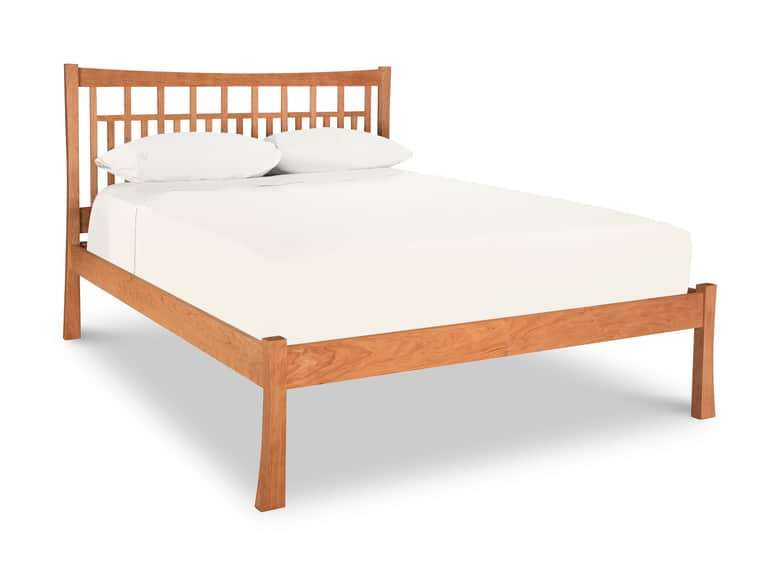
Furniture photographs are designed to make a bed look inviting. They are less useful at showing how far the frame projects beyond the mattress, whether the slats are appropriately spaced, or how a person with a book and a glass of water will reach the bedside table. Treat the image as evidence about appearance, not as a substitute for measurements and specifications.
A sensible comparison can be made with a short checklist:
- Confirm the mattress maker’s foundation, slat-spacing, and center-support requirements.
- Check the frame’s complete dimensions, including any ledge, headboard, or footboard.
- Calculate the finished bed height using the frame and mattress together.
- Measure room clearances, door swings, drawers, and routes around the bed.
- Inspect the center rail, support legs, slat attachment, and assembly instructions.
- Consider whether under-bed storage and cleaning access will work in practice.
- Choose a material and finish that suit both the room and the care you are prepared to provide.
These steps are not meant to drain the pleasure from choosing a bed. They make room for it. When support is sound and proportions are right, the frame can recede into the background in the best sense: no wobble, no awkward reach, no constant awareness of what should have been measured. The bed becomes part of the room’s quiet order, a structure that does its work without requiring an audience.
The frame as part of a room’s rhythm
Bedrooms are often asked to be restful, though they also have to accommodate the practical routines of dressing, reading, storing clothes, and navigating in the dark. A platform frame participates in all of them. Its height determines the first movement of the morning; its footprint influences how easily someone passes; its slats support the mattress night after night. These considerations are less visible than a color choice, but they have more to say about whether the room works.
Start with the mattress and the measurements, then consider the frame’s shape and finish. A low profile may be right for a tight room; a raised frame may provide useful clearance; an upholstered edge may give a plain space a softer center. Each decision has trade-offs, and a good one is not the most fashionable or the most elaborate. It is the one whose support, height, and proportions make sense for the people who will actually use it.
In the end, a platform frame is not merely a platform. It is a quiet negotiation between the body and the room, between the mattress’s requirements and the floor plan’s limitations. Measure carefully, verify the details, and choose a construction that fits the way you live. The result need not call attention to itself. A well-chosen bed has the rarer quality of making the room feel as though it has always known where it was going.